
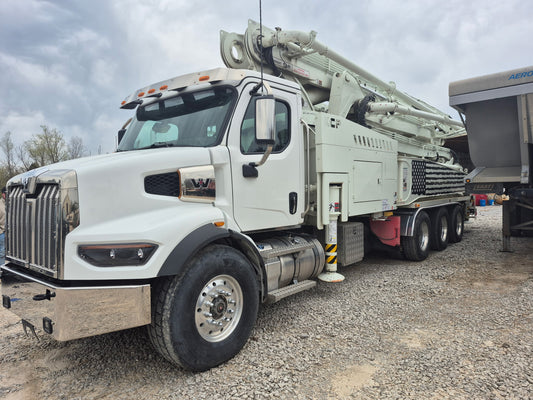
 Missouri


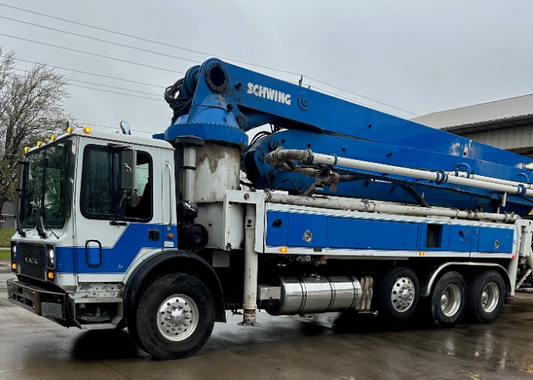


Buying used concrete pump trucks saves 30-60% compared to new equipment while delivering production-ready capabilities. Critical factors include documented pumping hours, and brand-specific technologies like Putzmeister's closed-loop hydraulics or Schwing's S-Valve systems. Our nationwide inventory includes inspected units with complete service histories.
Understanding Concrete Pump Trucks
Concrete pump trucks are specialized vehicles that transport and place concrete at construction sites where traditional methods fall short. These mobile units combine a concrete pump with an extendable boom mounted on a truck chassis, enabling precise concrete placement at height, distance, or in hard-to-reach locations.
Types of Concrete Pumping Equipment
Boom Pump Trucks feature hydraulic articulating arms that can extend 20-70 meters, making them essential for high-rise construction, bridge decks, and projects requiring vertical or horizontal reach. Available in Z-fold and R-fold configurations, these trucks navigate obstacles while maintaining precision. A 38-meter boom handles most residential and low-rise commercial work, while 47-meter+ booms provide the reach needed for high-rise construction and increased job site versatility—directly impacting resale value and rental income potential.
Line Pumps (also called trailer-mounted or ground pumps) use flexible hoses to move concrete horizontally across job sites. More portable than boom trucks, line pumps excel at residential foundations, swimming pools, shotcrete applications, and projects with consistent concrete demands at ground level.
Truck-Mounted Concrete Mixers with Pumps combine mixing and pumping capabilities in a single unit, ideal for remote sites or projects requiring on-demand concrete production and immediate placement.
What Influences Concrete Pump Pricing
New vs. Used Condition: Used concrete pump trucks typically cost between $50,000 to $400,000 depending on age, hours, and maintenance history. Newer models with low hours command premium prices, while older units with documented service records offer cost-effective entry points—qualifying for Section 179 tax deductions in the year of purchase and improving EBITDA by avoiding large capital expenditures.
Boom Reach & Certification: Longer booms increase versatility and price. Boom inspections verify structural integrity and hydraulic system safety. A 32-meter boom truck serves different applications than a 61-meter unit, with pricing reflecting both capability and market demand.
Brand Reputation: Putzmeister, Schwing, and KCP dominate the North American market with proven reliability. Brand recognition affects resale value, parts availability, and equipment appraisal accuracy.
Truck Chassis: The carrier vehicle—typically Mack, Peterbilt, Freightliner, or Western Star—impacts longevity, maintenance costs, and operator comfort. Newer chassis with emission-compliant engines meet current regulations and avoid costly retrofitting.
Pumping Capacity: Output measured in cubic yards per hour determines productivity. Higher-capacity pumps move more concrete faster but require more robust components and consume more fuel per hour.
Popular Concrete Pump Brands
Schwing: German-engineered pumps known for S-Tube valve technology and exceptional durability. Schwing's Rock Valve design minimizes wear on high-aggregate mixes, extending service intervals from 15,000 to 25,000+ cubic yards between major component replacements. Their wireless remote proportional controls allow operators to fine-tune boom speed and concrete flow from optimal vantage points.
Putzmeister: Industry leader in boom design and automation. Putzmeister trucks feature closed-loop hydraulic systems, precise boom articulation, and comprehensive service networks across North America. Their variable displacement pumps automatically adjust output pressure based on line length and concrete viscosity—reducing operator fatigue and improving consistency on high-rise construction projects.
KCP: Cost-effective alternative offering solid performance and straightforward maintenance. KCP pumps are popular among mid-sized contractors balancing capability with investment. Standard open-loop hydraulics simplify field repairs, and widespread Mack chassis compatibility ensures parts availability.
Detailed Concrete Pump Specs to Compare
When evaluating concrete pump trucks, examine these critical specifications:
- Boom Reach and Configuration: Vertical reach (determines floor count capability) and horizontal reach (affects setup locations and traffic management). Z-fold booms provide maximum vertical reach; R-fold booms offer better obstacle navigation
- Pumping Output: Cubic yards per hour capacity—directly correlates to jobs completed per day and revenue potential
- Maximum Pressure: PSI rating for various concrete mixes and line lengths. Higher pressure maintains flow through 200+ feet of line or 30+ stories vertical
- Engine Type and Hours: Diesel engine model (Cummins, Detroit, Caterpillar), emissions tier (Tier 3/4), and accumulated operating hours—pumping hours matter more than chassis mileage
- Truck Chassis Details: Make, model, year, odometer mileage, and axle configuration (6x4, 8x4)—affects weight permits and bridge law compliance
- Hydraulic System: Pump type (piston, squeeze, peristaltic), valve design (S-Valve, Rock Valve, swing-tube), and oil filtration system
- Outrigger Spread: Stabilization footprint affecting setup requirements—compact spreads suit urban job sites; wider spreads provide stability for maximum boom extension
- Hopper Capacity: Concrete receiving volume between truck deliveries—larger hoppers reduce wait time for ready-mix trucks
Maintenance Schedule & Operating Costs
Understanding maintenance requirements helps budget for total ownership costs beyond purchase price.
| Frequency | Maintenance Tasks | Typical Cost | Why It Matters |
|---|---|---|---|
| Daily | Clean hopper and delivery line, grease boom pivot points, inspect hydraulic hoses | $50-100 (labor/materials) | Prevents concrete buildup that causes premature wear and line blockages |
| Monthly | Hydraulic oil analysis, lubricate swing bearing, inspect outrigger cylinders | $200-400 | Early detection of hydraulic contamination prevents $15,000+ pump rebuilds |
| Annually | Boom inspection, cutting ring measurement, delivery cylinder bore check, NDT testing on structural components | $2,500-5,000 | Required for insurance coverage and OSHA compliance; identifies wear before catastrophic failure |
| Per 2,000 Hours | Hydraulic oil/filter change, pump piston replacement, wear plate inspection | $3,000-6,000 | Maintains manufacturer warranties and ensures consistent pumping pressure |
Concrete Pump Frequently Asked Questions
What's the difference between a boom pump and a line pump?
Boom pumps mount articulating arms (20-70 meters) on truck chassis for placing concrete at height and distance. Line pumps are trailer-mounted units using flexible hoses for ground-level horizontal placement.
- Boom pumps handle high-rise construction (10+ stories), bridge decks, and complex geometry where vertical reach is essential
- Line pumps excel at residential foundations, ground-level commercial slabs, and shotcrete applications where portability matters more than reach
- Boom pumps require CDL operators and outrigger setup; line pumps offer faster mobilization with 2-person crews
How many hours is considered high for a used concrete pump truck?
Well-maintained pump trucks regularly exceed 12,000-15,000 pumping hours. Hours matter less than maintenance documentation.
What is the average lifespan of a used concrete pump?
15-20 years with proper maintenance, translating to 15,000-25,000+ total pumping hours across the equipment's service life.
- Chassis longevity: Truck frames and engines can exceed 20 years with regular oil changes and transmission service
- Boom structures: Steel booms last indefinitely with annual inspections and corrosion prevention—most boom failures result from operator error, not age
- Hydraulic pumps: Major rebuilds every 8,000-12,000 hours extend pump life indefinitely. Schwing and Putzmeister pumps commonly operate 20+ years with 2-3 rebuilds
- Replacement triggers: Economics (repair costs exceeding 40% of replacement value), obsolescence (parts unavailable), or emission regulation changes forcing chassis retirement
What concrete mixes can pump trucks handle?
Modern concrete pumps handle standard structural mixes, self-consolidating concrete (SCC), fiber-reinforced mixes, and lightweight aggregates.
- Maximum aggregate size: Typically 3/4" to 1.5" depending on delivery line diameter (4", 5", 6" common). Larger aggregate requires larger bore pumps
- Slump requirements: 4-6 inch slump pumps easily; stiff mixes (under 3 inch) require higher pressure and cause faster wear
- Special mixes: High-fiber content (over 3% by volume) may require larger line diameter. Self-consolidating concrete pumps efficiently but demands precise pressure control
- Pump limitations: Very stiff mixes (zero-slump precast), extremely lightweight mixes (under 90 pcf), and mixes with aggregate over 2" typically require specialized equipment
Find Your Ideal Concrete Pump
Explore a wide array quality used concrete pumps for sale at BIC Auctions. Our inventory encompasses models from renowned brands like CIFA, EVERDIGM, Liebherr, Putzmeister, and Schwing, providing solutions tailored to your construction requirements.
Related Categories: Concrete Mixer Trucks | Truck Mounted Conveyor Belts | Knuckle Boom Crane Trucks